Ancient Greek philosophy

Plato and Aristotle in
The School of Athens fresco, by
Raphael. Plato is pointing heavenwards to the sky, and Aristotle is gesturing to the world.
Platonism
Main article:
Platonism
Plato, a pupil of
Socrates, was one of the earliest, most influential philosophers. His reputation comes from his
idealism of believing in the existence of
universals. His
Theory of Forms proposes that universals do not physically exist, like objects, but as heavenly forms. In the
dialogue of
The Republic, the character of
Socrates describes the
Form of the Good. His theory on justice in the soul relates to the idea of happiness relevant to the question of the meaning of life.
In Platonism, the meaning of life is in attaining the highest form of knowledge, which is the
Idea (
Form) of the Good, from which all good and just things derive utility and value.
Aristotelianism
Main article:
Aristotelian ethics
Aristotle, an apprentice of
Plato, was another early and influential philosopher, who argued that ethical knowledge is not
certainknowledge (such as
metaphysics and
epistemology), but is
general knowledge. Because it is not a
theoretical discipline, a person had to study and practice in order to become "good"; thus if the person were to become
virtuous, he could not simply study what virtue
is, he had to
be virtuous, via virtuous activities. To do this, Aristotle established what is virtuous:
Every skill and every inquiry, and similarly, every action and choice of action, is thought to have some good as its object. This is why the good has rightly been defined as the object of all endeavor [...]
Everything is done with a goal, and that goal is "good".
—
Nicomachean Ethics 1.1
Yet, if action A is done towards achieving goal B, then goal B also would have a goal, goal C, and goal C also would have a goal, and so would continue this pattern, until something stopped its
infinite regression. Aristotle's solution is the
Highest Good, which is desirable for its own sake. It is its own goal. The Highest Good is not desirable for the sake of achieving some other good, and all other "goods" desirable for its sake. This involves achieving
eudaemonia, usually translated as "happiness", "well-being", "flourishing", and "excellence".
What is the highest good in all matters of action? To the name, there is almost complete agreement; for uneducated and educated alike call it happiness, and make happiness identical with the good life and successful living. They disagree, however, about the meaning of happiness.
—
Nicomachean Ethics 1.4
Cynicism
Main article:
Cynicism (philosophy)
Antisthenes, a pupil of
Socrates, first outlined the themes of Cynicism, stating that the purpose of life is living a life of
Virtue which agrees with
Nature. Happiness depends upon being self-sufficient and master of one's mental attitude; suffering is the consequence of false judgments of value, which cause negative
emotions and a concomitant vicious character.
The Cynical life rejects conventional desires for
wealth,
power,
health, and
fame, by being free of the possessions acquired in pursuing the conventional.
[60][61] As reasoning creatures, people could achieve happiness via rigorous training, by living in a way natural to
human beings. The
world equally belongs to everyone, so
suffering is caused by false judgments of what is valuable and what is worthless per the
customs and
conventions of
society.
Cyrenaicism
Main article:
Cyrenaics
Aristippus of Cyrene, a pupil of
Socrates, founded an early Socratic school that emphasized only one side of Socrates's teachings - that happiness is one of the ends of moral action and that pleasure is the supreme good; thus a
hedonistic world view, wherein bodily gratification is more intense than mental pleasure. Cyrenaics prefer immediate gratification to the long-term gain of delayed gratification; denial is unpleasant unhappiness.
[62][63]
Epicureanism
Main article:
Epicureanism
Epicurus, a pupil of the Platonist Pamphilus of Samos, taught that the greatest good is in seeking modest pleasures, to attain tranquility and freedom from fear (
ataraxia) via knowledge, friendship, and virtuous, temperate living; bodily pain (
aponia) is absent through one's knowledge of the workings of the world and of the limits of one's desires. Combined, freedom from pain and freedom from fear are happiness in its highest form. Epicurus' lauded enjoyment of simple pleasures is quasi-ascetic "abstention" from sex and the appetites:
"When we say ... that pleasure is the end and aim, we do not mean the pleasures of the prodigal or the pleasures of sensuality, as we are understood to do, by some, through ignorance, prejudice or wilful misrepresentation. By pleasure we mean the absence of pain in the body and of trouble in the soul. It is not by an unbroken succession of drinking bouts and of revelry, not by sexual lust, nor the enjoyment of fish, and other delicacies of a luxurious table, which produce a pleasant life; it is sober reasoning, searching out the grounds of every choice and avoidance, and banishing those beliefs through which the greatest tumults take possession of the soul."
[64]
The Epicurean meaning of life rejects immortality and mysticism; there is a soul, but it is as mortal as the body. There is no
afterlife, yet, one need not fear death, because "Death is nothing to us; for that which is dissolved, is without sensation, and that which lacks sensation is nothing to us."
[65]
Stoicism
Main article:
Stoicism
Zeno of Citium, a pupil of
Crates of Thebes, established the school which teaches that living according to reason and virtue is to be in harmony with the universe's divine order, entailed by one's recognition of the universal
logos, or reason, an essential value of all people. The meaning of life is "freedom from
suffering" through
apatheia (Gr: απαθεια), that is, being
objective and having "clear judgement",
not indifference.
Stoicism's prime directives are
virtue,
reason, and
natural law, abided to develop personal self-control and mental fortitude as means of overcoming destructive
emotions. The Stoic does not seek to extinguish emotions, only to avoid emotional troubles, by developing clear judgement and inner calm through diligently practiced logic, reflection, and concentration.
The Stoic ethical foundation is that "good lies in the state of the soul", itself, exemplified in
wisdom and self-control, thus improving one's spiritual well-being: "
Virtueconsists in a
will which is in agreement with Nature."
[65] The principle applies to one's personal relations thus: "to be free from anger, envy, and jealousy".
[65]
Enlightenment philosophy
Further information:
Enlightenment philosophy
The
Enlightenment and the
colonial era both changed the nature of European philosophy and exported it worldwide. Devotion and subservience to God were largely replaced by notions of inalienable natural rights and the potentialities of reason, and universal ideals of love and compassion gave way to civic notions of freedom, equality, and citizenship. The meaning of life changed as well, focusing less on humankind's relationship to God and more on the relationship between individuals and their society. This era is filled with theories that equate meaningful existence with the social order.
Classical liberalism
Classical liberalism is a set of ideas that arose in the 17th and 18th centuries, out of conflicts between a growing, wealthy, propertied class and the established aristocratic and religious orders that dominated Europe. Liberalism cast humans as beings with inalienable natural
rights (including the right to retain the wealth generated by one's own work), and sought out means to balance rights across society. Broadly speaking, it considers
individual liberty to be the most important goal,
[66]because only through ensured liberty are the other inherent rights protected.
There are many forms and derivations of liberalism, but their central conceptions of the meaning of life trace back to three main ideas. Early thinkers such as
John Locke,
Jean-Jacques Rousseau and
Adam Smith saw humankind beginning in the
state of nature, then finding meaning for existence through labor and property, and using
social contracts to create an environment that supports those efforts.
Kantianism
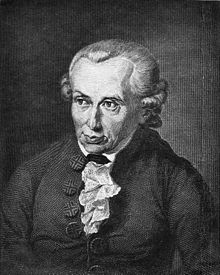 Immanuel Kant
is regarded as one of the most influential thinkers of the late
Enlightenment.
Kantianism is a philosophy based on the
ethical,
epistemological, and
metaphysical works of
Immanuel Kant. Kant is known for his
deontological theory where there is a single moral obligation, the "
Categorical Imperative", derived from the concept of
duty. Kantians believe all actions are performed in accordance with some underlying
maxim or principle, and for actions to be ethical, they must adhere to the categorical imperative.
Simply put, the test is that one must universalize the maxim (imagine that all people acted in this way) and then see if it would still be possible to perform the maxim in the world without contradiction. In
Groundwork, Kant gives the example of a person who seeks to borrow money without intending to pay it back. This is a contradiction because if it were a
universal action, no person would lend money anymore as he knows that he will never be paid back. The maxim of this action, says Kant, results in a contradiction in conceivability (and thus contradicts perfect duty).
Kant also denied that the consequences of an act in any way contribute to the moral worth of that act, his reasoning being that the physical world is outside one's full control and thus one cannot be held accountable for the events that occur in it.
19th century philosophy
Further information:
19th century philosophy
Utilitarianism
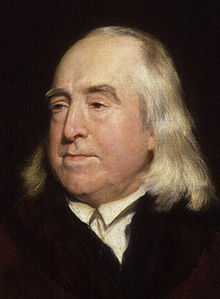 Jeremy Bentham
The origins of
utilitarianism can be traced back as far as
Epicurus, but, as a school of thought, it is credited to
Jeremy Bentham,
[67] who found that "nature has placed mankind under the governance of two sovereign masters, pain and pleasure", then, from that moral insight, deriving the
Rule of Utility: "that the good is whatever brings the greatest happiness to the greatest number of people". He defined the meaning of life as the "
greatest happiness principle".
Jeremy Bentham's foremost proponent was
James Mill, a significant philosopher in his day, and father of
John Stuart Mill. The younger Mill was educated per Bentham's principles, including transcribing and summarizing much of his father's work.
[68]
Nihilism
Nihilism suggests that life is without objective meaning.
Friedrich Nietzsche characterized nihilism as emptying the world, and especially human existence, of meaning, purpose, comprehensible truth, and essential value; succinctly, nihilism is the process of "the devaluing of the highest values".
[69] Seeing the nihilist as a natural result of the idea that
God is dead, and insisting it was something to overcome, his questioning of the nihilist's life-negating values returned meaning to the Earth.
[70]
 The End of the World
, by John Martin.
To
Martin Heidegger, nihilism is the movement whereby "
being" is forgotten, and is transformed into value, in other words, the reduction of being to exchange value.
[69] Heidegger, in accordance with Nietzsche, saw in the so-called "
death of God" a potential source for nihilism:
If God, as the supra-sensory ground and goal, of all reality, is dead; if the supra-sensory world of the Ideas has suffered the loss of its obligatory, and above it, its vitalizing and up-building power, then nothing more remains to which Man can cling, and by which he can orient himself.[71]
The French philosopher
Albert Camus asserts that the
absurdity of the
human condition is that people search for external values and meaning in a world which has none, and is indifferent to them. Camus writes of value-nihilists such as
Meursault,
[72] but also of values in a nihilistic world, that people can instead strive to be "heroic nihilists", living with dignity in the face of absurdity, living with "secular saintliness", fraternal solidarity, and rebelling against and transcending the world's indifference.
[73]
20th-century philosophy
Further information:
20th-century philosophy
The current era has seen radical changes in both formal and popular conceptions of human nature. The knowledge disclosed by modern science has effectively rewritten the relationship of humankind to the natural world. Advances in medicine and technology have freed humans from significant limitations and ailments of previous eras;
[74] and philosophy—particularly following the
linguistic turn—has altered how the relationships people have with themselves and each other are conceived. Questions about the meaning of life have also seen radical changes, from attempts to reevaluate human existence in biological and scientific terms (as in
pragmatism and
logical positivism) to efforts to meta-theorize about
meaning-making as a personal, individual-driven activity (
existentialism,
secular humanism).
Pragmatism
Pragmatism, originated in the late-19th-century U.S., to concern itself (mostly) with
truth, positing that "only in struggling with the environment" do data, and derived theories, have meaning, and that
consequences, like utility and practicality, are also components of truth. Moreover, pragmatism posits that
anything useful and practical is not always true, arguing that what most contributes to the most human good in the long course is true. In practice, theoretical claims must be
practically verifiable, i.e. one should be able to predict and test claims, and, that, ultimately, the needs of humankind should guide human intellectual inquiry.
Pragmatic philosophers suggest that the practical, useful understanding of life is more important than searching for an impractical abstract truth about life.
William James argued that truth could be made, but not sought.
[75][76] To a pragmatist, the meaning of life is discoverable only via experience.
Theism
Main article:
Philosophical theism
Theists believe God created the universe and that God had a purpose in doing so. Theists also hold the view that humans find their meaning and purpose for life in God's purpose in creating. Theists further hold that if there were no God to give life ultimate meaning, value and purpose, then life would be absurd.
[77]
Existentialism
Main article:
Meaning (existential)
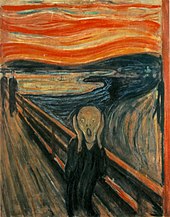 Edvard Munch
's
The Scream, a representation of
existential angst.
According to existentialism, each man and each woman creates the essence (meaning) of their life; life is not determined by a supernatural god or an earthly authority, one is free. As such, one's ethical prime directives are
action,
freedom, and
decision, thus, existentialism opposes
rationalism and
positivism. In seeking meaning to life, the existentialist looks to where people find meaning in life, in course of which using only reason as a source of meaning is insufficient; this gives rise to the emotions of
anxiety and
dread, felt in considering one's
free will, and the concomitant awareness of death. According to
Jean-Paul Sartre,
existence precedes essence; the (
essence) of one's life arises
only after one comes to
existence.
Søren Kierkegaard spoke about a "
leap", arguing that
life is full of absurdity, and one must make his and her own values in an indifferent world. One can live meaningfully (free of despair and anxiety) in an unconditional commitment to something finite, and devotes that meaningful life to the commitment, despite the vulnerability inherent to doing so.
[78]
Arthur Schopenhauer answered: "What is the meaning of life?" by stating that one's life reflects one's will, and that the will (life) is an aimless, irrational, and painful drive. Salvation, deliverance, and escape from suffering are in aesthetic contemplation, sympathy for others, and
asceticism.
[79][80]
For
Friedrich Nietzsche, life is worth living only if there are goals inspiring one to live. Accordingly, he saw nihilism ("all that happens is meaningless") as without goals. He stated that asceticism denies one's living in the world; stated that values are not objective facts, that are rationally necessary, universally binding commitments: our evaluations are interpretations, and not reflections of the world, as it is, in itself, and, therefore,
all ideations take place from a particular perspective.
[70]
Absurdism
Main article:
Absurdism
"
... in spite of or in defiance of the whole of existence he wills to be himself with it, to take it along, almost defying his torment. For to hope in the possibility of help, not to speak of help by virtue of the absurd, that for God all things are possible – no, that he will not do. And as for seeking help from any other – no, that he will not do for all the world; rather than seek help he would prefer to be himself – with all the tortures of hell, if so it must be."
Søren Kierkegaard,
The Sickness Unto Death[81]
In absurdist philosophy, the Absurd arises out of the fundamental disharmony between the individual's search for meaning and the apparent meaninglessness of the universe. As beings looking for meaning in a meaningless world, humans have three ways of resolving the dilemma. Kierkegaard and Camus describe the solutions in their works,
The Sickness Unto Death (1849) and
The Myth of Sisyphus (1942):
- Suicide (or, "escaping existence"): a solution in which a person simply ends one's own life. Both Kierkegaard and Camus dismiss the viability of this option.
- Religious belief in a transcendent realm or being: a solution in which one believes in the existence of a reality that is beyond the Absurd, and, as such, has meaning. Kierkegaard stated that a belief in anything beyond the Absurd requires a non-rational but perhaps necessary religious acceptance in such an intangible and empirically unprovable thing (now commonly referred to as a "leap of faith"). However, Camus regarded this solution as "philosophical suicide".
- Acceptance of the Absurd: a solution in which one accepts and even embraces the Absurd and continues to live in spite of it. Camus endorsed this solution (notably in his 1947 allegorical novel The Plague or La Peste), while Kierkegaard regarded this solution as "demoniac madness": "He rages most of all at the thought that eternity might get it into its head to take his misery from him!"[82]
Secular humanism
Further information:
Secular Humanism

The "
Happy Human" symbol representing
Secular Humanism.
Per
secular humanism, the
human species came to be by reproducing successive generations in a progression of
unguided evolution as an integral expression of
nature, which is self-existing.
[83][84] Human knowledge comes from human observation, experimentation, and rational analysis (the
scientific method), and not from supernatural sources; the nature of the
universe is what people discern it to be.
[83] Likewise, "
values and realities" are determined "by means of intelligent inquiry"
[83] and "are derived from human need and interest as tested by experience", that is, by
critical intelligence.
[85][86] "As far as we know, the total personality is [a function] of the biological organism transacting in a social and cultural context."
[84]
People determine human purpose without supernatural influence; it is the human personality (general sense) that is the purpose of a human being's life.
Humanism seeks to develop and fulfill:
[83] "Humanism affirms our ability and responsibility to lead ethical lives of personal fulfillment that aspire to the greater good of humanity".
[85] Humanism aims to promote
enlightened self-interest and the
common good for all people. It is based on the premises that the
happiness of the individual person is inextricably linked to the well-being of all humanity, in part because humans are social animals who find meaning in
personal relations and because cultural progress benefits everybody living in the
culture.
[84][85]
The philosophical subgenres
posthumanism and
transhumanism (sometimes used synonymously) are extensions of humanistic values. One should seek the advancement of
humanity and of
all life to the greatest degree feasible and seek to reconcile
Renaissance humanism with the 21st century's
technoscientific culture. In this light, every living creature has the right to determine its personal and social "meaning of life".
[87]
From a
humanism-psychotherapeutic point of view, the question of the meaning of life could be reinterpreted as "What is the meaning of
my life?"
[88] This approach emphasizes that the question is personal—and avoids focusing on cosmic or religious questions about overarching purpose. There are many therapeutic responses to this question. For example,
Viktor Frankl argues for "Dereflection", which translates largely as: cease endlessly reflecting on the self; instead, engage in life. On the whole, the therapeutic response is that the question itself—what is the meaning of life?—evaporates when one is fully engaged in life. (The question then morphs into more specific worries such as "What delusions am I under?"; "What is blocking my ability to enjoy things?"; "Why do I neglect loved-ones?".)
See also: Existential Therapy and Irvin Yalom
Logical positivism
Logical positivists ask: "What is the meaning of life?", "What is the meaning in asking?"
[89][90] and "If there are no objective values, then, is life meaningless?"
[91]Ludwig Wittgenstein and the
logical positivists said:[
citation needed] "Expressed in language, the question is meaningless"; because,
in life the statement the "meaning of x", usually denotes the
consequences of x, or the
significance of x, or
what is notable about x, etc., thus, when the meaning of life concept equals "x", in the statement the "meaning of x", the statement becomes
recursive, and, therefore, nonsensical, or it might refer to the fact that biological life is essential to having a meaning in life.
The things (people, events) in the life of a person can have meaning (importance) as parts of a whole, but a discrete meaning of (the) life, itself, aside from those things, cannot be discerned. A person's life has meaning (for themselves, others) as the life events resulting from their achievements, legacy, family, etc., but, to say that life, itself, has meaning, is a misuse of language, since any note of significance, or of consequence, is relevant only
in life (to the living), so rendering the statement erroneous.
Bertrand Russell wrote that although he found that his distaste for torture was not like his distaste for broccoli, he found no satisfactory, empirical method of proving this:
[65]
When we try to be definite, as to what we mean when we say that this or that is "the Good," we find ourselves involved in very great difficulties. Bentham's creed, that pleasure is the Good, roused furious opposition, and was said to be a pig's philosophy. Neither he nor his opponents could advance any argument. In a scientific question, evidence can be adduced on both sides, and, in the end, one side is seen to have the better case — or, if this does not happen, the question is left undecided. But in a question, as to whether this, or that, is the ultimate Good, there is no evidence, either way; each disputant can only appeal to his own emotions, and employ such rhetorical devices as shall rouse similar emotions in others ... Questions as to "values" — that is to say, as to what is good or bad on its own account, independently of its effects — lie outside the domain of science, as the defenders of religion emphatically assert. I think that, in this, they are right, but, I draw the further conclusion, which they do not draw, that questions as to "values" lie wholly outside the domain of knowledge. That is to say, when we assert that this, or that, has "value", we are giving expression to our own emotions, not to a fact, which would still be true if our personal feelings were different.
[92]
Postmodernism
Further information:
Postmodernism
Postmodernist thought—broadly speaking—sees human nature as constructed by language, or by structures and institutions of human society. Unlike other forms of philosophy, postmodernism rarely seeks out
a priori or innate meanings in human existence, but instead focuses on analyzing or critiquing
given meanings in order to rationalize or reconstruct them. Anything resembling a "meaning of life", in postmodernist terms, can only be understood within a social and linguistic framework, and must be pursued as an escape from the power structures that are already embedded in all forms of speech and interaction. As a rule, postmodernists see
awarenessof the constraints of language as necessary to escaping those constraints, but different theorists take different views on the nature of this process: from radical reconstruction of meaning by individuals (as in
deconstructionism) to theories in which individuals are primarily extensions of language and society, without real autonomy (as in
poststructuralism).
Naturalistic pantheism
According to
naturalistic pantheism, the meaning of life is to care for and look after nature and the environment.
Embodied cognition
Embodied cognition uses the neurological basis of emotion, speech, and cognition to understand the nature of thought.
Cognitive neuropsychology has identified brain areas necessary for these abilities, and genetic studies show that the gene
FOXP2 affects neuroplasticity which underlies language fluency.
George Lakoff, a professor of cognitive linguistics and philosophy, advances the view that metaphors are the usual basis of meaning, not the logic of verbal symbol manipulation. Computers use
logic programming to effectively query databases but humans rely on a trained
biological neural network. Post modern philosophies that use the indeterminacy of symbolic language to deny definite meaning ignore those who feel they know what they mean and feel that their interlocutors know what they mean. Choosing the correct metaphor results in enough common understanding to pursue questions such as the meaning of life. Improved knowledge of brain function should result in better treatments producing healthier brains. When combined with more effective training, a sound personal assessment as to the meaning of one’s life should be straightforward.