Kmjt's Guide About Training to Dunk

Introduction
Dunking can be a fascinating thing to watch, even if your not a basketball fan. Some people are born with the ability (genetics) and some have to work hard for it. In this guide I will get you well on your way to achieving your first dunk.
No Excuses
Let's get a few things straight right from the start:
- Race has NOTHING to do with your ability to jump. No race is any better than another in terms of jumping, however some races do have slightly larger hands making it easier for them to dunk with one hand since they can palm a basketball with ease.
- Genetics only plays a MINOR factor in someone's potential to jump high. It's true that some people may plateau there vertical leap and never jump as high as someone else due to genetics, however EVERYONE is capable of potentially training to a 40 inch vertical jump (assuming you're healthy.)
Determine Your Preference
Everyone has a jumping preference. By this I mean if you are more comfortable jumping off of one leg or both legs. It is important for you to determine this before proceeding to your training.
You can determine your preference by simply trying out both. Do you jump higher off of one leg or both legs on a RUNNING start? Take note of what method you jump higher doing as this will help you maximize your training.
If you are uncertain of the difference between a one leg jumper and a two leg jumper research Jason Richardson (two leg jumper) and Lebron James (one leg jumper.)


Left or Right Jumper?
This is assuming you are a one leg jumper. If you are unsure consider this: Someone pushes you from behind; which leg did you use to stop you from falling (which leg did you put out)? This would be the leg you are comfortable jumping off of and is most likely your stronger leg.
The Many Aspects
There are many aspects to work on simultaneously to achieving a higher vertical jump (it's not all about having strong legs):
- Approach
- Diet
- Cardio
- Working Out
Approach
Correcting an improper approach alone could add 4 inches to your vertical jump.
Two leg jumping:
- Run to the basket.
- On your last step get very low to the ground.
- Explode up while thrusting your arms up with the ball.
- Let your momentum carry you upwards.
One leg jumping:
- Run to the basket.
- *Unlike two leg jumping, you don't get very low to the ground.*
- Explode upwars off of your dominate leg while thrusting your arms up with the ball.
- Let your momentum carry you upwards.
Diet
This should be a no brainer but i'll take you through it anyway. If your serious about dunking you have to be serious about your diet if you expect to maximize your results. If fat is weighing you down you won't be able to jump as high as you potentially could. Someone who weighs 150 pounds compared to someone with the exact same leg strength who weighs 200 pounds will jump many inches higher.
With that being said, i'm not suggesting that you starve yourself. Get your body fat percentage as low as you could while still eating proper meals and lots of protein. If your not getting a significant amount of protein each day your workouts will almost be pointless; you need protein to build muscle in your legs!
If you have the extra money to do so, buy whey protein. You don't have to buy the most expensive kind (even Wal Mart sells it.)

Cardio
Cardio and Diet basically go along with each other in the sense that the healthier you eat the more weight you lose and the more you run the more weight you lose. Fat holds you down when you jump so losing it is a priority.

Working Out
Before we get into the workouts here are some common mistakes people training their vertical jump frequently make:
- High repetition exercises. This is the worst thing you can do if you want to jump higher. By training in high repeitions you are training your endurance, NOT your strength. To jump higher you need to train for strength, which is in the 1-8 repitition range.
- Overtraining. A person who trains once a week intensly compared to someone who trains every 2nd day medicore (because his muscles are still sore) will see better results. Your legs need time to recover. If you want to get stronger, you need to give your legs a lot of time to recover.
Mixing in weight training with plyometrics will give you the best results. In this guide were only going to be weight training our legs once a week and doing plyometrics once a week. It is important to spread these 2 days out among the seven days in the week because they will be intense training days. Since we are only weight training our legs once a week, we have to train INTENSE. An example workout schedule would be as followed:
Monday: plyometrics
Tuesday: cardio/core
Wednesday: arm/back/shoulder weight training
Thursday: cardio/core
Friday: leg weight training
Saturday: cardio/core
Sunday: rest
This schedule may be too intense/ not intense enough for you. Only you can fairly judge how your body would react to certain workout schedules. If this is too much core (upper/lower abdominals) training for you; take some core days out. If you already have a very low body fat percentage; take cardio days out (unless you actually want to get in better cardio shape.) If you want to add more weight training days that don't involve your legs; feel free. This is just a sample schedule that should be changed around to suit your own body. Make sure you are only working out your legs and plyometics once a week with reasonable days rest in between (leg rest.)
Leg Weight Training Exercises
Weighted Squats

Squatting is probably THE best weight training exercise for dunking. Remember that form is more important than weight. Only increase the weight if your form is perfect and you are capable of doing more than 6 repetitions. Make sure you are doing full squats; get your butt all the way to the ground. Full squats with less weight are much better than quarter squats with more weight. When you enter the gym leave your ego at the door. If you are too scared to freely squat you can use the machine. If you don't have access to squatting at all you can leg press instead (although squatting is a lot better.)
- 3 sets of 4-6 repeitions.
- Proper form.
- Be intense. Explode up when squatting.
Weighted Calf Raises

Weighted calf raises is the ONLY leg weigh training exercise that I sometimes go over my 8 repetition rule. This is to make sure your doing the exercise right. If you go too heavy sometimes your range of motion is horrible.
- 3 sets of 8-12 repetitions.
- Explode up.
- Make sure there is a large range of motion.
Hamstring Curls

Many people hate this exercise but it's a must; strong hamstrings have just as much to do with jumping as quadriceps.
- 3 sets of 5-8 repetitions.
- Explode your feet to your butt when doing this exercise.
Weighted Lunges

- Choose a weight that is right for you, usually between 10-40 pound dummbells in each hand.
- 3 sets of 16 repetitions (8 repetitions per leg.)
- Holding a dummbell in each hand, lunge forward with any leg to start and EXPLODE back up into the starting position.
- If you can't balance easily during this exercise you need lighter dummbells.
- Alternate between each leg (left leg, right leg, left leg, right leg, etc.)
Back Weight Training Exercises
Having a strong back only plays a minor factor in being able to jump high, but since it's still one of the facets i'll throw in one of the best back exercises aimed at training your vertical jump. Note that this exercise is also a leg exercise, but I decided to label it as a back exercise.
Dead Lifts

Warning: Watch an instructional video on how to perform a proper deadlift. Words cannot describe this exercise because done wrong it can severely injure your back. For the purpose of this guide I will give a short explanation just so you get the just of it, but make sure you watch an instructional video before performing this dangerous exercise!
- 3 sets of 5-8 repetitions.
- While arching your back, slightly bend your knees.
- Grab on to the bar.
- Carefully lift up. I don't suggest doing this exercise with explosion because it is so easy to injure your back doing so. Since the back isn't a major facet in getting a higher vertical jump, just do this exercise slowly and safely. If you feel you can properly do this exercise with explosion feel free to.
- Slowly set the bar down and repeat.
- If the weight used is substantionally high you should use a belt.
Core Training Exercises
Once again core is another word for someone's abdominals. Having a strong core WILL help you jump higher. We want to train for a STRONG core, so this means we WON'T be doing the following:
- High repetition core exercises. For example: sets of 100 crunches (this will only define your core, not make it stronger.)
Were not here for looks. If you want to get a defined six pack find another program. Although doing core strength should get you a noticeable six pack if you are doing your cardio.
I'm only going to mention one exercise that I believe to be excellent for achieving a strong core:
Plank

Hold the position in the picture for as long as you can. Set goals and try to improve every time; if you held it for a minute a week ago try holding it for a minute and twenty seconds this time.
- 3 sets of holding as long as you can.
- Make sure you feel the tension in your abdominals.
This is only one core exercise but there are many others out there. When doing any core exercise remember: NEVER go over 8 repetitions or you are no longer training strength. If your in love with crunches you need to add weight.
Plyometric Exercises
Plymoetic exercises almost always consist of jumping. Use this rule for all of your plyometic exercises: When you can no longer continue doing the exercise with as much intensity as you started with, STOP. If you don't, you are training your leg's endurance which is bad as I stated earlier. In some exercises I may say there are various ways to do it depending on if you are a one leg or two leg jumper, however if you do it the one leg way assume to do it with your stronger leg AND weaker leg. This is to avoid muscle imbalances.
Depth Jumps
- 4 sets of 8 repetitions (stop if intensity is lowering.)
- Start standing on top of a box.
- Let yourself fall off of the box and EXPLODE up into the air as soon as you touch the ground. Explode with one or both feet.
- It is important that you try to explode as soon as you touch the ground from letting yourself fall off of the box.
Lateral Box Jumps

- 4 sets of 8 repetitions (each jump over the box counts as one repetition.)
- Facing forward, jump back and forth over the box without stopping, jumping as high as you can each time.
- Avoid landing on top of the box and potentially making a fool out of yourself.
Rim Jumps
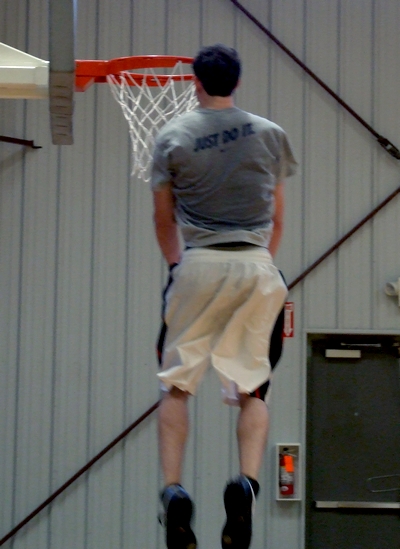
- 4 sets of 8 repetitions (if the intensity lowers stop.)
- Can be done with one or both legs.
- Start by standing directly under a basketball hoop.
- Jump and repeatedly jump as soon as you land again.
- The point of the exercise is to try to jump your highest each and every time while having your hands in the air touching as high over/under the rim as you can (picture does not demonstrate arms up.)
Lunge Jumps

- 4 sets of 8 repetitions (if intensity lowers stop.)
- Start off as if you had just lunged forward.
- In this position explode up into the air.
- In the air change the positioning of your legs so that when you land you will be lunged forward with your other leg (opposite leg from starting position lunge.)
Sprinting

Even though there is little to say about sprinting I decided to give it its own section. Sprinting fast and jumping high are in a way related. If you have the strong legs to be a fast sprinter, chances are you are a decent jumper to begin with. Sprinters go through many of the same weight training exercises that jumpers do. Squatting is an essential exercise for sprinters.
With that being said, sprinting should be done every week to help towards your jumping ability:
- 4 sets of 100M sprint.
Conclusion
Once again I will give you the message I have been trying to drill in your head:
If you want to jump higher you must train for STRENGTH (no higher than 8 repetitions in most cases.)
Let your body recover. You will be amazed at how little of time you need to spend training in order to achieve a higher vertical jump. DON'T OVERTRAIN YOUR LEGS!