
• Log in or sign up for an account here: https://www.sythe.org/login

Cool

Two Factor Authentication User
Easter 2013
Doge
Community Participant
I'm doing no surgery on the word. A quick comparison to help you understand is imagine you are in a real feeling dream or something similar. Many people have completely real feeling dreams. They only realize they aren't a dream when they wake to refute it. So while they were dreaming they were assuming their senses were real.
The senses were a valid tool to ascertain knowledge about the dream world. You're proceeding to the next line of inquiry, that is, how do we know our senses give us information about the ultimate real reality as opposed to a quasi-reality. We can't; this really isn't a problem however, as practically speaking we live in our quasi-reality, so even if the world we live in is not real, there are still objective principles that govern it, that ought to ascertain, and that we must live by to succeed in it. That argument doesn't detract however from the validity of the senses in the world we are in.

It's still an assumption even if it's at the most fundamental level.
It really isn't, see below.

You need not deny the validity of your senses to make the claim that they are an assumption. You can completely believe in your senses and still know that they are an assumption.
No. An assumption basically is belief without reason. Here the belief is that our senses are valid. You say that we have no reason to believe them (otherwise it wouldn't be an assumption; gravity is not an assumption because we can empirically test it, not withstanding our empirical testing is, as your friend asserts, based on an assumption). The question then is how do we justify the validity of our senses. Like I said, the justification of the senses (which absolves their status as an assumption), is their irrefutability. Note that even if people assume the validity of their senses without knowing its justification, that doesn't mean the validity of our senses cannot be justified.

Irrefutability is extremely important to its justification. The counter that it is an assumption does not work, because the irrefutability of our senses kicks in when you try to deny it, not when you take no position saying that it is an assumption. It kicks in when you say 'the senses are not valid' or something of that nature. In which case you have contradicted yourself for reasons I have previous stated. This leaves 2 other options. Either our senses are valid, or if you want to be nit-picky, x% (say 99%) of our senses are valid (valid in being able to give good info about reality). Those being the ONLY two options available after you recognize the contradiction of denying the senses. Those conclusions being justified, what recourse then do you have to say that our senses are based on an assumption, when we have reason to believe that at worst a large percentage of our sensory information gives us information about the real world?


Your senses are of course an assumption. They are an assumption we all have to live with and don't care much about, but an assumption nonetheless.
As I said, surgery on what assumption means. You are trying to define away an assumption having no justification, or simply not recognizing the justification. There is a justificaiton from the validity of the senses a priori, and thus that being the case, still saying that they are an assumption is flat-out incorrect. They are justified, and justified statements are not assumptions. Now unless your friend wants to say reasoning is based on an assumption, point out that he is contradicting himself again.


I must say, do not conflate the issue of a quasi-reality, with the validity of our senses in the world we are in. We can live in a quasi-reality, and our senses can be valid in giving us information about that quasi-reality. Science then, since operating in our quasi reality, is not based on an assumption, since it is justified with the validity of our senses in said quasi reality as outlined above. The issue of a quasi-reality, and the validity of our senses are separate from one another, although the quasi-reality problem, in my view, follows immediately from the validity of our senses issue.
 
Gohan has AIDS
Sythe's 10th Anniversary
There's no foundation for ANY debate when you claim that objective measurements and results are inadmissible because humans are the ones observing them........

I agree completely.
 
So where all results are negative, the condition is negligible. Provided our senses are reliable enough to accurately read the results of completely impartial and precise tests for scientific experiments, we can conclude the results are not assumed, they are hypothesized and true until proven false. Thus the difference between religion and science, which was the original point I already made on the first page of this thread.
 
Gohan has AIDS
Sythe's 10th Anniversary
So where all results are negative, the condition is negligible. Provided our senses are reliable enough to accurately read the results of completely impartial and precise tests for scientific experiments, we can conclude the results are not assumed, they are hypothesized and true until proven false. Thus the difference between religion and science, which was the original point I already made on the first page of this thread.

I don't disagree with you, I was merely pointing out that his argument isn't the ability to prove facts with science and religion the opposite. His argument is that we rely on what our senses deliver to our brain, for us to translate it and make an understanding for what our sense delivered. However, we assume that what was received was in fact what happened, so our senses are true to us. As this isn't exactly something than can be proven it's therefore an assumption. And his argument is saying that religion's faith, and the faith you have in the "truth" you receive from your senses are the same.

They're not. However, neither can be proven.

It's a common argument that fits in the is my blue your red box.


I'm not disagreeing with you, I'm pointing out that you're not addressing his point. He also agrees with you, he just wanted some arguments to present to counter what he's provided.

Ok but then what's the use of this argument? That's like saying "unicorns are as real as horses because you see with your eyes". It's an argument of semantics whose answer doesn't benefit anyone intellectually or philosophically. If that really is what OP and his friend are debating then I'll leave them to it. More constructive conversations are worth having than this
 
Gohan has AIDS
Sythe's 10th Anniversary
Ok but then what's the use of this argument? That's like saying "unicorns are as real as horses because you see with your eyes". It's an argument of semantics whose answer doesn't benefit anyone intellectually or philosophically. If that really is what OP and his friend are debating then I'll leave them to it. More constructive conversations are worth having than this

I was trying to let you know you were wasting your time with intellectual discussion for his argument. The point in the argument a long with the majority of theistical arguments is "well you can't prove this, so it makes you on the same level as me". It's just an irrational argument, as it's quite obvious what our senses deliver to us is accurate and it's fair to say a commonality between all of us.

Just another case of disprove something that hasn't been proven to exist.
 
The whole point of a debate is not convince the other party to convert, but to bounce ideas back and forth and knock out possible errors, but not rule out the fact that it could be just a variable.
Debates turn into extremism when the other party starts to harp and preach on the other parties ideas that's when you get these kinds of threads where civil discussion is like a #blacklivesmatter rally doing more harm than good.
 
What the hell are you talking about?? Debates are quite literally purposed to convince the other side that they're wrong with sound logic and rhetoric. Either way though, it doesn't matter what the point is when the resulting ideas are just as useless as the topic.
 
Two Factor Authentication User
Halloween 2015
Tier 1 Prizebox
I might not be fully understanding your point, but here is a practical example between religion and science. Lets say both scientists and religious people at one point believed that the Sun revolved around the Earth, because their senses made them think that. Scientists are willing to change their entire perspective of the cosmos if they are given sufficient evidence, because they know their senses are unreliable.

Also, noting that we get our knowledge of science through the senses doesn't add any validation to religion, because religion makes extraordinary claims far beyond anything that has to do with the senses.

This post hit the nail right on the head. The premise is false and the argument can be dismissed.
 
Gohan has AIDS
Sythe's 10th Anniversary
Convince the other side LOL

If the objective of a debate is not to convince as many as possible to your logic, then there would be no point in a debate.

If you have a debate where it's a 50:50 for:against then a vote at the end would be pointless unless you were to convince some of the opposing side to see sense.

If that's not the case, then our "intellectual discussion" is nothing more than arguing.

Well no one has conceded on the issue or is progressed towards one so yeah, arguing lol
 
I was in a heated argument with a friend who had said that science was no better than or different from religion.

The premise of his argument was science and religion both were assumption based beliefs.

Both require you to believe what your senses are telling you to be true. So if you feel God or transcendence or whatever it's as trustworthy as seeing two apples and therefore knowing there is two apples.

When trying to explain "god feelings" or anything of that sort can be explained by science his rebuttal can always be that I am assuming I can trust my senses when I make that claim and am therefore no better than the religion when they trust their "godsense" if you will.

He thinks both were built on the framework that you can trust what your senses are telling you. So if all these people feel as though they have a greater power connection, it's as well grounded as anything else is.

So he is saying since science operates under an assumption it is also a belief and no more fact than anything.

I find this argument absurd, but running it in circles in my head, there's no way I can see to escape it. I have multiple arguments in mind, but I can think of ways this stupid argument could "beat" them.

Thoughts?

Put your best argument here and see if I can't apply his argument to it and win.

This argument was a while ago. So I may have to consider your arguments a while before I remember his rebuttals. And I may not have laid out his argument in it's best form, so I may edit it to better perfect the argument.

Here's the thing, though - ALL belief relies upon the senses being reliable, literally every single one. However, science ONLY relies upon our senses being reliable - and then not even always. Religion adds a few (dozen) more assumptions into the mix, so you can simply retort that your beliefs are simpler and have less chances to be flawed. ;)
 
My physics university professor once said in our class that the if the sun and the earth's distance were off slightly, there would be no life on earth. However, miraculously, we are at the optimum range and therefore life exists because of that.

This is a good read of Incredible design of Earth and the Solar System that proves that there is evidence of a higher power: http://www.godandscience.org/apologetics/designss.html
 
Gohan has AIDS
Sythe's 10th Anniversary
My physics university professor once said in our class that the if the sun and the earth's distance were off slightly, there would be no life on earth. However, miraculously, we are at the optimum range and therefore life exists because of that.

This is a good read of Incredible design of Earth and the Solar System that proves that there is evidence of a higher power: http://www.godandscience.org/apologetics/designss.html

No, what you are saying is because it's unlikely to have happened therefore there is a creator. This is an assumption based on nothing except that it's unlikely.
 
No, what you are saying is because it's unlikely to have happened therefore there is a creator. This is an assumption based on nothing except that it's unlikely.

How can you justify things that are seemingly perfect (aka how our body is constructed)?
 
Gohan has AIDS
Sythe's 10th Anniversary
How can you justify things that are seemingly perfect (aka how our body is constructed)?

There is nothing perfect about the human body. It's all a matter of evolution and how we've evolved into our environment. As with all other creatures.

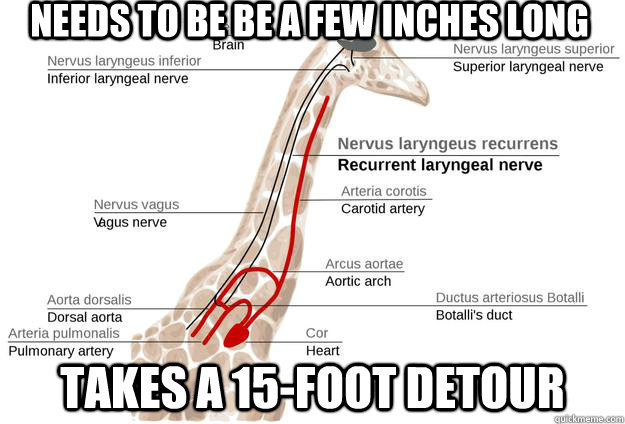
In fact, to add to this the laryngal nerve of a giraffe proves your statement is incorrect.

If not, then how do you define perfect?

36cva6.jpg
 
There is nothing perfect about the human body. It's all a matter of evolution and how we've evolved into our environment. As with all other creatures.

Exactly, our body adapt to our environment. Animals do as well. Why does that seem so? I guess the true question is if you think we were created by a higher power. Because it seems that everything has a reason. How can "someone" forsee adapting is necessary to live?
 
Runescape Gamblingrunescape gambling
Back
Top