



• Log in or sign up for an account here: https://www.sythe.org/login

Why abstain from meat?

This is an extremely unrealistic and overly simplified argument.

Let's say a farmer rears the chickens, and then sells them to a wholesaler who on-sells to a retailer, or the farmer otherwise supplies directly to the retailer. You have an impact on the retailer side, not the farmer side. Thus, you would be reducing the revenue of the store by one chickens worth. Alternatively, you are increasing the stores waste by 1 chicken. The retailer is unlikely to sell every single chicken it purchases. Some chickens will be stolen, some chickens will be of poor quality, some chickens will sit on the shelf and exceed their use-by date, and be trashed. You not purchasing one chicken is highly unlikely to exert a 1/1000 chance of reducing the rearing of 1000 chickens.

Let us say your store purchases 10000 chickens per week for consumers. It allocates 4% of those chickens to waste/theft. That means it expects to sell 9,600 chickens. Let us assume it purchases each of these chickens for $10, and sells them for $20, with operating expenses of $5. In total, a 25% margin.

Lets assume the 2% of chickens allocated to waste/theft didn't form part of the operating expenses. The maximum revenue the store could get from those chickens is $200,000/week, with a $50,000 profit on 25% margin. Only expecting to sell 9,600 chickens however, its real revenue is reduced to $192,000, with a profit of $48,000.

Let us assume that the 4% of figure changes slightly from week to week (sometimes there may be more waste/theft, and sometimes less). Let us assume a normal distribution, with 9,600 chickens sold per week being the mean with a SD of 50 chickens. I will run some analysis of what 10 weeks of revenues/net profits are for this store, and to summarise the parameters:

Mean: 9,600
SD: 50

21e40e2b7b3cb278476a8a5e43818db4.png


Now, tell me how you think you no longer buying 1 chicken a week is going to be detected by the store when the range of chickens they sold was 97 (Week 10 - Week 1). Your protest falls within their expected variance. It is an immaterial difference. Even if it did make a difference, all the store would do was buy less chickens from the wholesaler/farmer. It does not follow automatically that from a reduced order from one store (of thousands) that therefore the farmer will necessarily cut the supply of chickens (because the farmer would have a natural variance too).

I agree that every one counts, and that if thousands of people protested a small difference may be made, but to say that every individual has a 1/1000 chance of affecting chicken production rates is a huge oversimplification and ignores the complexities of reality. Even my brief analysis was an oversimplificaiton.

Notes: In hindsight probably only very large stores would sell 10,000 chickens/week. Nevertheless, it makes no difference how many chickens the store sells, since ultimately they demand chickens from the farmer, and if the store sells fewew chickens, they demand fewew chickens from the farmer, so even if you make a proportionally greater difference in a smaller store, that smaller store wields proportionally less buying power than a large store. This also ignores retailers vertically integrated with primary producers. Also, the market is not perfectly efficient.

So, I'll absolutely agree that my example was extremely over simplified. I'll also agree that the market is not perfectly efficient, which can't be helped.

However, if somebody, somehow, with perfect economic data and perfect knowledge about everybody's buying patterns was able to quantify the likelihood of my wallet affecting the local, regional, or national chicken supply: The more unlikely my individual purchase is to effect change (as your example shows it is), the more significant an impact it has. If my purchase is the swinging point for a large supermarket corporation to scale its chicken farming down by 1 unit for the next quarter, for a certain region, then that has a tremendous overall impact.

(also apologies if I only respond occasionally, I travel a great deal for work)
 
Last edited:
Two Factor Authentication User
Easter 2013
Doge
Community Participant
So, I'll absolutely agree that my example was extremely over simplified. I'll also agree that the market is not perfectly efficient, which can't be helped.

However, if somebody, somehow, with perfect economic data and perfect knowledge about everybody's buying patterns was able to quantify the likelihood of my wallet affecting the local, regional, or national chicken supply: The more unlikely my individual purchase is to effect change (as your example shows it is), the more significant an impact it has. If my purchase is the swinging point for a large supermarket corporation to scale its chicken farming down by 1 unit for the next quarter, for a certain region, then that has a tremendous overall impact.

(also apologies if I only respond occasionally, I travel a great deal for work)
I agree that if your purchase price is the swinging point, then your purchase has an impact. However, in reality, how can it be that your purchase, and your purchase alone, that is the swinging point (I very much doubt every other consumers probability of making an impact is 0, whereas your is 1)? If there are 10 million consumers of chicken weekly, logically then, couldn't any one of their purchases also be the swinging point? If we hypothetically assume that the answer is yes, then you have a P(0.0000001) of being that swinging point (1/10 million). No matter how you cut it, practically speaking your purchase is simply not going to make a difference - you'd have a better chance at winning second prize in the lottery.

I understand you want to assume perfect information, but this simply isn't going to happen - and since you are making an ethical argument about how one should act in the real world (or at least explaining your position) recourse to unrealistic and un-analogizable hypotheticals isn't sufficient in this case.

I also don't agree with the premise that the more unlikely an event, the more significant an impact the event will have if it actualizes. For example, it is highly unlikely that I will go to toilet on campus today because I have a toilet in my room, and the toilet on campus is 15 minutes away. Yet, even if that unlikely probability materialises, me using the campus toilet is not a significant event. Significance of an event in actuality is not predicated on its low probability.

Ultimately, we are talking about expected significance here, not actual significance. Thus, even if you successfully argue that the actual significance is going to be extremely big, the expected significance is still extremely small due to the low probability. For example, the actuality of winning the lottery is a very significant event, but the expected significance of every lottery ticket purchase is very small:

P(0.000000001) * 1,000,000 + P(0.999999999) * 0 = 0.001.


What type of work do you do?
 
It's not probability. Every chicken bought is a chicken killed. It's not like stores order x amount of chickens every week and throw out the renaming ones. If the number of chickens a store has goes below a certain threshold then they'll reorder. So if a stores threshold is 10 chickens and you buy a chicken then the store will have to reorder sooner. If you don't buy chicken then the store will take longer to reoder.

TLDR 1 chicken bought = 1 chicken killed. Because they don't kill chickens and throw them away. You guys are really overthinking it.
 
Last edited:
It's not probability. Every chicken bought is a chicken killed. It's not like stores order x amount of chickens every week and throw out the renaming ones. If the number of chickens a store has goes below a certain threshold then they'll reorder. So if a stores threshold is 10 chickens and you buy a chicken then the store will have to reorder sooner. If you don't buy chicken then the store will take longer to reoder.

TLDR 1 chicken bought = 1 chicken killed. Because they don't kill chickens and throw them away. You guys are really overthinking it.

Are you actually suggesting that all the chicken gets sold all the time? I know for a fact it does not and chicken on the counter has to get thrown away. Especially considering the shelf life of chicken is so much more of an important factor for it compared to other foods; this isn't canned tuna with preservatives its live meat.
 
Are you actually suggesting that all the chicken gets sold all the time? I know for a fact it does not and chicken on the counter has to get thrown away. Especially considering the shelf life of chicken is so much more of an important factor for it compared to other foods; this isn't canned tuna with preservatives its live meat.
That's negligible though. If they have to much extra they'll reorder less. Regardless of how much they order the amount wasted won't change much.
 
Two Factor Authentication User
Easter 2013
Doge
Community Participant
That's negligible though. If they have to much extra they'll reorder less. Regardless of how much they order the amount wasted won't change much.
Stores always write-off a certain amount of stock to waste/theft. Your one chicken would be immaterial to their calculations; they wouldn't be able to differentiate between a reduction in demand from local consumers and an amount of wastage which varies by more than 1 chicken from week-to-week.

Regardless, whether a store re-orders isn't the ultimate problem, it's whether the chicken farm produces chickens unethically. Even if 1 store reorders slightly less, another store will reorder slightly more. That the chicken farmer will adjust their production by 1 chicken due to 1 store reordering less is highly unlikely. Even if both retailer and primary producer were vertically integrated, the market is still not perfectly efficient.
 
Two Factor Authentication User
Easter 2013
Doge
Community Participant
I've made all these exact arguments. They just resorted to repeating that I don't know math. Waste of time. Apparently "1 out of a million chance magically cancels out" even if you don't buy a million chickens. I don't think either of us will understand that math.
If you have a 1/million chance of reducing 1 million chickens (saving their lives), then the expected reduction of your not purchasing 1 chicken is 1 chicken, which cancels out (P(0.000001) * 1,000,000 = 1). I think that was the reference Shredderbeam made earlier on with 1,000 chickens. I just don't agree with the probabilities.
 
Two Factor Authentication User
Easter 2013
Doge
Community Participant
Right and I'm saying it doesn't convert like that in real life. The store and farmers don't cancel 1 for 1.
We're talking about expected values here, so although in reality yes, they don't cancel out, from the perspective of probability based on the EV, they do. If you run a Monte Carlo simulation, given enough trials, you'll also find that they cancel out.
 
Two Factor Authentication User
Easter 2013
Doge
Community Participant
Are we not talking about reality? No wonder this was a waste of my time. I'm trying to come to ACTUAL conclusions :p I told Shredder I agree with his math like 8 times, but putting up equations doesn't automatically mean anything towards finding out what is the truth unless they are the right equations that consider all the real life variables.
But anyway, I'll concede to a hypothetical argument. If that's what you guys want I'm out. I'll be living in the real world haha
Yes, but in reality, given enough trials they actually do cancel out... run a Monte Carlo simulation and see for yourself (though you'd probably need 100million to 1billion trials at a 1/1,000,000 probability). This is kind of how the world of finance works - it's not perfect (far from it), but it is the real world.
 
Stores always write-off a certain amount of stock to waste/theft. Your one chicken would be immaterial to their calculations; they wouldn't be able to differentiate between a reduction in demand from local consumers and an amount of wastage which varies by more than 1 chicken from week-to-week.

Regardless, whether a store re-orders isn't the ultimate problem, it's whether the chicken farm produces chickens unethically. Even if 1 store reorders slightly less, another store will reorder slightly more. That the chicken farmer will adjust their production by 1 chicken due to 1 store reordering less is highly unlikely. Even if both retailer and primary producer were vertically integrated, the market is still not perfectly efficient.

Stores look at the number of chickens they sold to know how many to reorder. They might round their orders to say 10, so buying 1 chicken has a 1/10 chance of having 10 chickens ordered. Thus you can still expect one less chicken bought it one less ordered.

Same idea for a chicken farm if they round to 1000 chickens then your 1 chicken could cause 1000 more chickens to be ordered.
 
Two Factor Authentication User
Easter 2013
Doge
Community Participant
Stores look at the number of chickens they sold to know how many to reorder. They might round their orders to say 10, so buying 1 chicken has a 1/10 chance of having 10 chickens ordered. Thus you can still expect one less chicken bought it one less ordered.

Same idea for a chicken farm if they round to 1000 chickens then your 1 chicken could cause 1000 more chickens to be ordered.
If a store sold 1,000 chickens, it would not re-order 1,000 chickens, because some chickens may be lost due to theft/wastage. If the theft/wastage percentage is 4%, then stores might add 4% on-top of last-weeks sales. Additionally, sales may vary naturally from week-to-week. Let's say the mean chickens sold per week is 1,000, with a SD of 20 chickens. Stores would probably want to stay on the safe side and not want to understock, so let's say they purchase the mean + 3SD's worth of chickens + account for a 4% wastage/ spilling statistic. That equates to (1,000 + 60) * 1.04 chickens bought = 1102 chickens. You not purchasing 1 chicken is going to make a negligible difference to the mean, SD and wastage of chickens, the statistics the store uses in order to predict what quantity of chickens to purchase in order to optimise their profits. It is not likely that a store will only look at the absolute number of last week's purchase to determine what they should re-order - there are various techniques they use. What I have stated is but one technique. Whatever the case, buying 1 chicken does not automatically guarantee a 1/10 chance of having 10 chickens ordered, because the purchase of that 1 chicken is within the stores expected variance of chicken purchases. Why would a store alter the size of its order when the chickens purchased by consumers is within its expected variance? It's not - it is only likely to change if a significant difference is detected - one chicken is not going to cut it.

Again, markets are inefficient, and strategies differ. You might get a store manager who decides to drop prices and increase the quantity of chickens purchased! Determining the probability is a hopelessly difficult task, but, whatever the case, thinking that 1 chicken is going to be detected by the company is very optimistic, considering that 1 chicken relative to the company's gross sales is probably immaterial for accounting purposes.
 
Last edited:
Only if they were rounding there would be a 1/10 chance theyd get 10 more chickens.
Using your example:
Didnt buy chicken:
(1,000 + 60) * 1.04 chickens bought = 1102 chickens
You bought a chicken:
(1,001 + 60) * 1.04 chickens bought = 1103.44 chickens
So in this case buying a chicken equated to more than one chicken being bought. All I'm saying is that every chicken you buy you can expect about 1 more chicken will be produced. You're right there's other factors that could increase or decrease your influence, but there's a direct correlation between the amount of chickens bought and the amount produced. You can see this by your formula that the amount of chickens purchased (1000) is the largest factor in your formula.
 
Last edited:
Two Factor Authentication User
Easter 2013
Doge
Community Participant
Only if they were rounding there would be a 1/10 chance theyd get 10 more chickens.
Using your example:
Didnt buy chicken:
(1,000 + 60) * 1.04 chickens bought = 1102 chickens
You bought a chicken:
(1,001 + 60) * 1.04 chickens bought = 1103.44 chickens
So in this case buying a chicken equated to more than one chicken being bought. All I'm saying is that every chicken you buy you can expect about 1 more chicken will be produced. You're right there's other factors that could increase or decrease your influence, but there's a direct correlation between the amount of chickens bought and the amount produced. You can see this by your formula that the amount of chickens purchased (1000) is the largest factor in your formula.
1,000 is the mean. Adding 1 does not change the mean by 1.
 
1,000 is the mean. Adding 1 does not change the mean by 1.
Say they use the mean value of the number of chickens ordered in each of the last 3 months. Then the one chicken you buy is going to be counted for the next 3 months. 1/3 + 1/3 + 1/3 = 1
 
I agree that if your purchase price is the swinging point, then your purchase has an impact. However, in reality, how can it be that your purchase, and your purchase alone, that is the swinging point (I very much doubt every other consumers probability of making an impact is 0, whereas your is 1)? If there are 10 million consumers of chicken weekly, logically then, couldn't any one of their purchases also be the swinging point? If we hypothetically assume that the answer is yes, then you have a P(0.0000001) of being that swinging point (1/10 million). No matter how you cut it, practically speaking your purchase is simply not going to make a difference - you'd have a better chance at winning second prize in the lottery.

This is correct. I never said that my probability varies from others, only that the argument "I have a 1/x chance of a certain effect magnified by x, mathematically averages out. So in short, the idea of "lol my dollar vote doesn't matter" is simply false.

malakadang said:
assume perfect information, but this simply isn't going to happen - and since you are making an ethical argument about how one should act in the real world (or at least explaining your position) recourse to unrealistic and un-analogizable hypotheticals isn't sufficient in this case.

No perfect information is required, and I haven't made an argument as to how one should act.

malakadang said:
I also don't agree with the premise that the more unlikely an event, the more significant an impact the event will have if it actualizes. For example, it is highly unlikely that I will go to toilet on campus today because I have a toilet in my room, and the toilet on campus is 15 minutes away. Yet, even if that unlikely probability materialises, me using the campus toilet is not a significant event. Significance of an event in actuality is not predicated on its low probability.

No, it's not necessarily predicated, but when it comes to supply and demand, mathematically, a 1/10 chance for a 1000% reward averages out. I'm not saying people should take that 1/10 chance - I'm saying that the argument "well it's only a 1/10 chance it'll never happen" makes zero sense.

malakadang said:
Ultimately, we are talking about expected significance here, not actual significance. Thus, even if you successfully argue that the actual significance is going to be extremely big, the expected significance is still extremely small due to the low probability. For example, the actuality of winning the lottery is a very significant event, but the expected significance of every lottery ticket purchase is very small:

P(0.000000001) * 1,000,000 + P(0.999999999) * 0 = 0.001.

The lottery is a fallacious example because it doesn't average out to $1 spent = $1 earned.


malakadang said:
What type of work do you do?

I'm a financial advisor that specifically focuses on retirement (401k, IRAs, etc.). I get to do a lot of workshops all over the U.S., though it normally consists of telling blue-collar workers "hey, saving is good, maxing out your credit cards is bad, the stock market is not the devil", and "your recently elected Democratic state senator will probably not plunge the country into full-on communism". It's frustrating work sometimes, but I enjoy helping people get their act together.
 
Two Factor Authentication User
Easter 2013
Doge
Community Participant
This is correct. I never said that my probability varies from others, only that the argument "I have a 1/x chance of a certain effect magnified by x, mathematically averages out. So in short, the idea of "lol my dollar vote doesn't matter" is simply false.
Random chance will make more of a difference than your dollar vote. I don't disagree with the notion that your vote has an effect, infinitesimal or otherwise, I am just rejecting the notion that the EV of chickens saved if 1 for 1. That sounds like quite a seductive figure, yet if in actuality it is more, when I abstain from buying 1 chicken, I am saving 0.0001 chickens... it becomes less seductive. When people say 'my dollar vote doesn't matter', being charitable, they probably mean it makes a negligible difference. 1 for 1 is not negligible; 10,000 for 1 arguably is negligible.


No perfect information is required, and I haven't made an argument as to how one should act.
Weren't you arguing that the strongest reason for abstaining from meat was due to it preventing animal suffering? The issue was then raised to what extent your voting with your wallet would make a difference. As much as the argument turned to basic statistics, ultimately you have to justify that for each dollar vote you make, the EV of that dollar vote is attractive. In other words, you are actually making a difference. Asserting that a 1/1000 chance to save 1,000 chickens results in an EV of 1 is mathematically correct, but doesn't address the point as to whether it is actually attractive, not whether it could be attractive.

"However, if somebody, somehow, with perfect economic data and perfect knowledge about everybody's buying patterns" If perfect economic data and perfect knowledge does not mean perfect information then I'm not sure what it was you were trying to say there?


No, it's not necessarily predicated,
I agree, which is why this statement: "The more unlikely my individual purchase is to effect change (as your example shows it is), the more significant an impact it has." is not accurate.

but when it comes to supply and demand, mathematically, a 1/10 chance for a 1000% reward averages out.
Absolutely, and a 1/10 chance of 1% does not, and so on.


The lottery is a fallacious example because it doesn't average out to $1 spent = $1 earned.
Which is precisely my point when not purchasing chickens!


In practice, the following must occur in order for your non-purchase of chickens to have an effect on chicken production.
  1. You must first not purchase the chicken;
  2. Your signal of not purchasing the chicken must be detected by the store you purchased the chicken from;
  3. Once detected, the store has to reduce their demand for chickens as a result of the signal you sent.
  4. The primary producer must detect the signal that their purchasers are reducing their demand for chickens.
  5. Once detected, the primary producer has to reduce their supply for chickens as a result of the signals the stores sent.
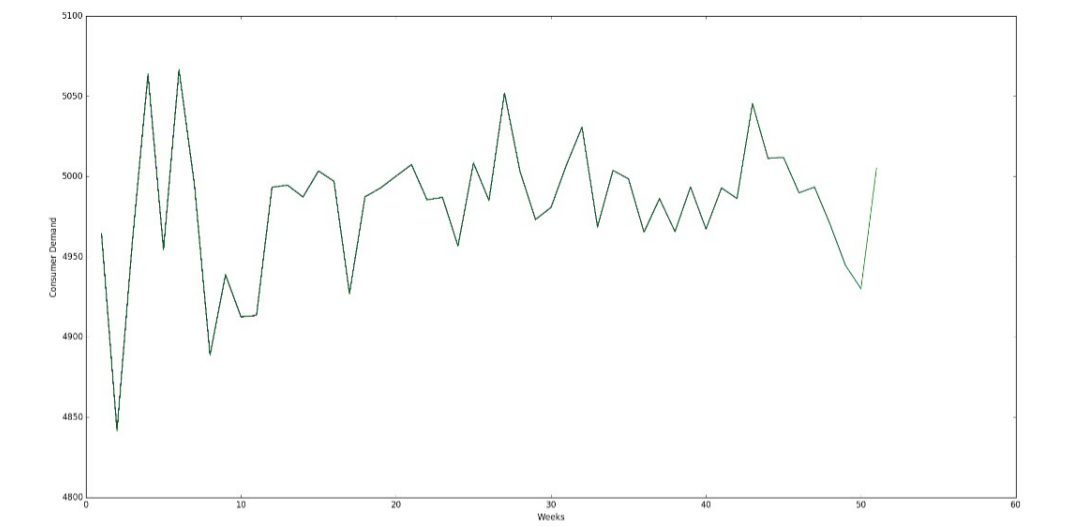
When you refuse to purchase one chicken, you reduce n by 1, yet that is still within the natural variance both the stores, and the primary producers expect, thus, it is unlikely they will even detect the markets signal in the first instance. Even if they do detect it, there is no guarantee that they will reduce demand/supply as a result of that signal. Let's have a little test. I have simulated a very angry consumer who, for 10 weeks, decided to not purchase 1 chicken, thus reducing quantity demanded by 1. Which weeks do you think this occurred at?

c65a70e874d712ac5b80fb9c165d7b8e.png


Some assumptions underlying the model (assuming normality, and not taking into account seasonal fluctuations, etc):
  • Mean Chickens Demanded was initially 5,000 with the SD at 100. Based on these parameters, 26 points were simulated.
  • From there, for each Week, consumers would demand a random number of chickens based on the mean and SD of that list of 26.
  • Once that number is determined, index 0 of the list was removed, and the new demand was appended onto the list (thus slightly altering the mean and SD of the list).
  • For a certain number of weeks, the (new demand - 1) was appended [the angry consumer]
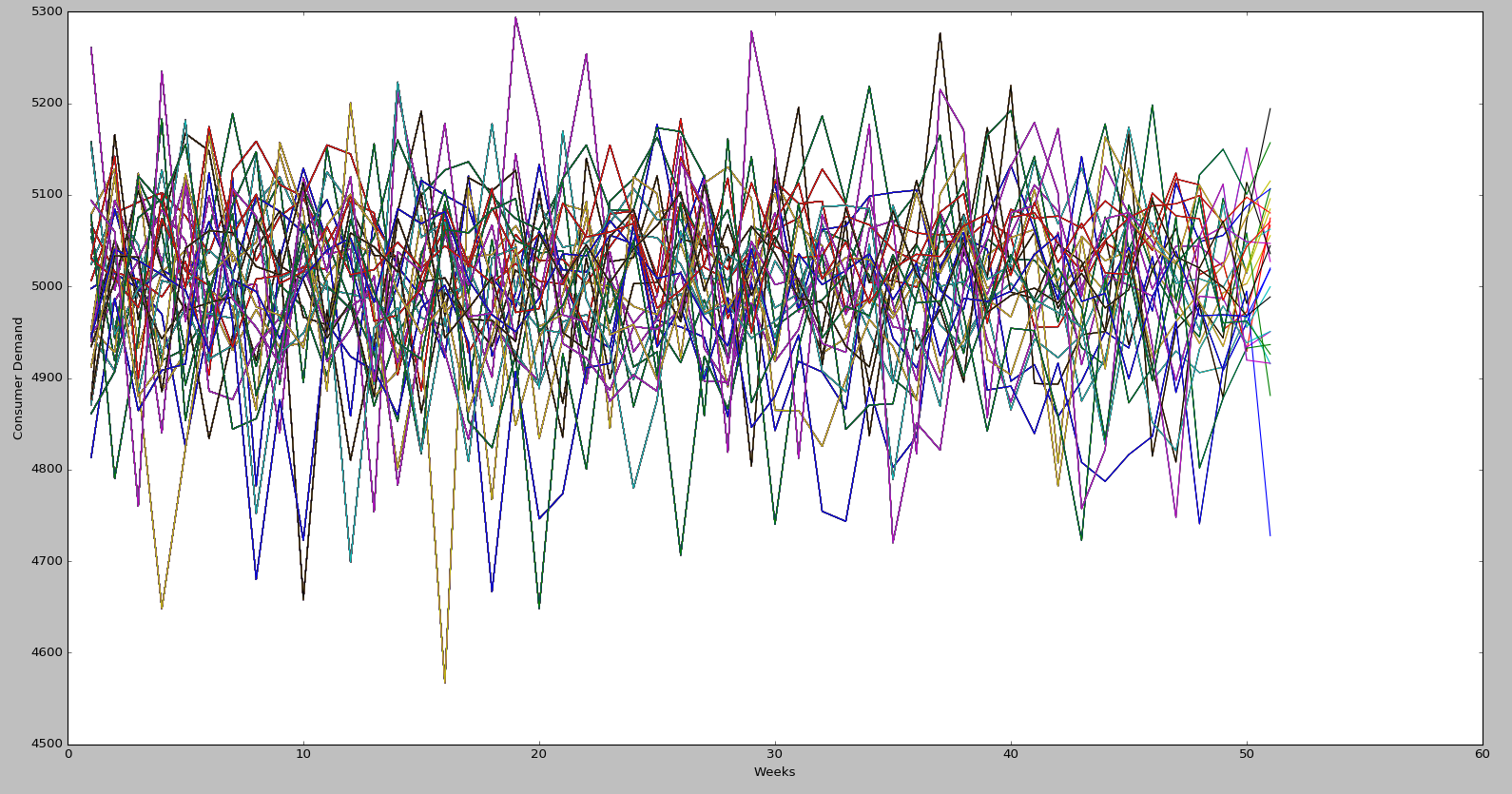
If you can spot the signal that one consumer was sending (and justify why), then I'll be pretty speechless. Ultimately the point I'm trying to prove is that it is pretty much impossible for such a signal to be detected because it falls within the natural variance of consumer demand. Random chance exerts a greater effect: here is what 30 simulations look like with the same above assumptions:

48301d0c785cf62c7918795f1bfee397.png


Even if you have data supporting x it would still be difficult to cause management to actually take the steps the data suggests should be taken. Even if you do (a) detect the signal and (b) cause management to act on it, you're still only up to step 4!
 
Last edited:
Detective
Trole
Pool Shark
Le Kingdoms Player
Member of the Month Winner
Sythe Awards 2014 Winner
I tried not eating meat for a total of 3 days. By the third day all I could think about was fat, greasy, juicy meat and ended up eating probably over 10,000 calories worth of meat that day. I wouldn't be able to abstain from meat.
 
Detective
Trole
Pool Shark
Le Kingdoms Player
Member of the Month Winner
Sythe Awards 2014 Winner
To add to my previous post, I think the main reason I was craving meat so bad was because I felt weak, tired, and sluggish without eating meat
 
Valentine's Singing Competition Winner
Sythe Awards 2015 Winner
Sythe Awards 2016 Winner
Sythe Awards 2020 Winner
Member of the Month Winner
MushyMuncher
Gohan has AIDS
Extreme Homosex
World War 3
I'm LAAAAAAAME
Discord Verified
Off Topic Participant
I tried not eating meat for a total of 3 days. By the third day all I could think about was fat, greasy, juicy meat and ended up eating probably over 10,000 calories worth of meat that day. I wouldn't be able to abstain from meat.

If all you did was remove meat from a normally omnivorous diet then you're lacking in nutrients that your body normally gets. You can get all the nutrients required by the body from plant-based foods. If you changed your diet over those 3 days to reflect that, chances are you wouldn't have had those cravings.

What you did is like cutting out water and wondering why you were thirsty. I've eaten strictly vegan for extended periods of time (much longer than 3 days) and didn't crave meat at all by the end. It's all about getting the nutrients your body requires.

As for eating meat, veganism is as ethical as it gets. If you know the kind of shit that goes on in the meat/dairy industries and you haven't even considered, thought , or gone through with reducing meat intake or going full veggie/vegan then you should probably see if you can get evaluated for sociopathic tendencies.

I hate debating veganism with people who have a large dietary intake of meat because their counter-arguments are either always shallow or fallacious. I have never heard a strong argument against veganism.
 
Last edited:
Detective
Trole
Pool Shark
Le Kingdoms Player
Member of the Month Winner
Sythe Awards 2014 Winner
If all you did was remove meat from a normally omnivorous diet then you're lacking in nutrients that your body normally gets. You can get all the nutrients required by the body from plant-based foods. If you changed your diet over those 3 days to reflect that, chances are you wouldn't have had those cravings.

What you did is like cutting out water and wondering why you were thirsty. I've eaten strictly vegan for extended periods of time (much longer than 3 days) and didn't crave meat at all by the end. It's all about getting the nutrients your body requires.

As for eating meat, veganism is as ethical as it gets. If you know the kind of shit that goes on in the meat/dairy industries and you haven't even considered, thought , or gone through with reducing meat intake or going full veggie/vegan then you should probably see if you can get evaluated for sociopathic tendencies.

I hate debating veganism with people who have a large dietary intake of meat because their counter-arguments are either always shallow or fallacious. I have never heard a strong argument against veganism.

I made sure I was getting the proper amount of protein from the veggies, but I just wasn't able to do it. My body craved meat, I'm a meat eater and I need meat in order to survive.
 
duelarena.gg
Back
Top