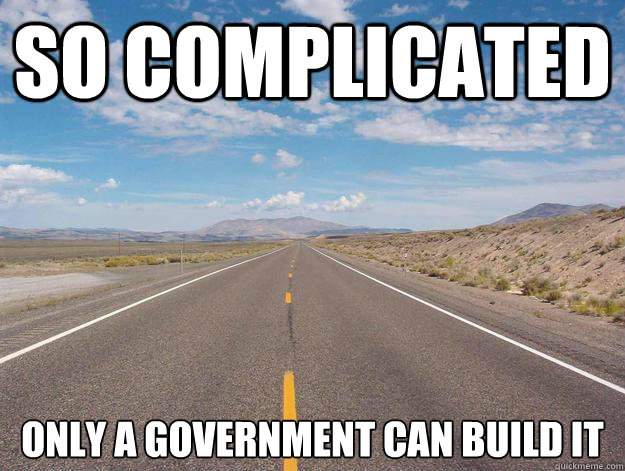
Wall of slavishly repeated statist maxims.
Ok I'll try respond briefly.
If your 5 meter bridge on private land breaks, what happens? Well... nothing, you need a new bridge. If it breaks on public land, then it potentially disrupts hundreds of thousands of people. The bridge needs to be built so that it will not break. (Not saying that yours will, but the importance that one is well done is much greater than the other).
1. Not all roads carry 100's of thousands of people.
2. There are hundreds of private toll and railways on private land which already manage just fine.
3. The whole point of the free market is to have competition so that you can use the competitor's road if your main route breaks.
4. Point 3 is how the internet works, replace road with internet pipe.
And of course public land is more expensive - there are regulations that must be met in order to benefit everybody, and these regulations have an overhead cost that must somehow be paid. Nobody wants a sewer plant next to a farm or a toxic waste treatment plant next to a school. On private land, you can potentially have little enough land that managing this is not a concern, but on a large scale, somebody needs to take care of this, and it incurs an overhead. (Perhaps the overhead could be smaller, but something must exist).
Bunch of shit. Look up the history of common law, particularly torts. We already have/had a working legal system which was vastly superior to the central planning 'zoning' nonsense we have now.
Well, the several fiat currencies that people actually trust (Euro, USD, AUS, etc the currencies of the big and powerful countries) have either just recently been established or been around for a while. I don't think that the statistic accurately portrays the stability of a US government bond.
Neither do I. Let me accurately portray the stability of a US government bond:
1. The US produces nearly nothing and buys most of its consumer and capital goods from china.
2. US government bonds are backed by the prommise to steal future US dollars from the future wages of US workers.
3. US produces nothing, and therefore taking US dollars from US workers to pay for chinese goods is paying for something with nothing.
4. US bonds are completely worthless.
As for slavery, I'll just refer to Swan's post earlier. I wouldn't really call it slavery for his reasons, but also because slavery sorta requires that somebody be profiting for all of the "hard work" that you do, and there doesn't seem to be anybody in this case.
Slavery is putting positive legal obligations on people according to the place and or time of their birth. Taxation is most definitely slavery. Further US 'citizens' are required to file US tax returns for 8 years after they immigrate to another tax farm / "country"/
The internet was a government-funded project. This analogy is like saying (because roads are much more expensive to install than some cables - much of the internet's worth is in the research required to create it) "Look - the government built some roads and found how to do it well, and now corporations have built off of the government's network, even replacing some of the government's roads, so therefore the corporations could have done all of this by themselves".
Strawman argument. Roads were initially built by Rome therefore the road I put through my property today is thanks to Rome?
Undersea and under land cables are not cheaper than roads.
Further, corporations themselves are just government created entities, you are still not talking about the free market.
Not in the United States.
http://en.wikipedia.org/wiki/Equal_Protection_Clause
If you really want to, you can say they smell bad and kick them out for that, but your basis for kicking them out cannot be their race.
So what you are saying is I can still kick someone out of my store because they are black or asian. In otherwords what you meant to write was "I agree".
No, I never say that government is evil. Sure, there are some things that I disagree with and that I think could be done better, but as a whole, the government is a beneficial institution.
If stealing money from people to pay for a standing army that routinely murders and rapes people both domestically (police) and internationally (military) is a beneficial institution then I don't know what to tell you.
The very reason you try so very very hard to justify the existence of the government and taxation is because you know it is plain flat out evil to steal, rape, murder and keep slaves. These are all the nearly exclusive domain of the government. For rape see: war rape.
The story is significant because the west had a better standard of living than the soviet woman thought -- but what is the "better alternative" for us?
To have a society based on voluntary interaction instead of one based on the initiation of force, of course.