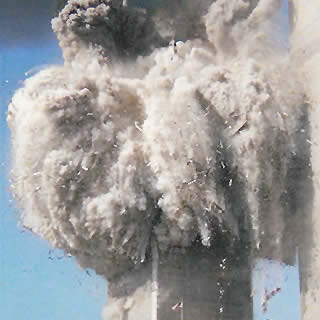
It's lazy and sloppy at best. The most I've seen they calculate is the speed of the fall, which is pretty fast indeed. But after that, they make childish "Year 10 Physics" assertions without taking in the obvious problems with real-life physics.
There's no real precedent case(building the same size, built the same way, stressed under the same conditions), or real math to back this up. So this isn't really a scientific viewpoint, just speculation.
It is Newtonian physics. That's what you study in year 10.
Have you read NIST's own reports? They reconstructed a huge section of floor in a furnace and put it under immense heat and pressure. Their mathematical model was so bad and so tortured that their experimental results were wildly divergent. They never recreated the phenomena they were asserting caused instantaneous explosive collapse.
See this is very clever, because there is no math, there is no mathematical model, and because there is no model, there is no authority for you to appeal to. 'The math' would only be useful if you had a working model of the towers. If you make a simple model: say a solid block, or a tube with a solid core and wafers, then the math is simple enough that it hardly need be considered. Needless to say the scale of the phenomenon and its likeness to existing phenomenon makes a highly complex model unnecessary. Occam's razor.
We know that net force = 0, if the normal force of the structure of the building is resisting gravity, and the building is not accelerating. So the structural integrity of the building must have provided at least enough force to hold the building against gravity. (1) That's premise one. And each of the lower floors must have provided enough structural normal force to hold up all of the floors above it against gravity (2). That's premise two.
Given that for each floor the net force must have been zero, and net force is the sum of relevant forces, you get:
net force = mass * acceleration (gravity) - mass * acceleration (normal force aka resistance) = 0.
The mass is constant for the entire building and for any given floor. So now we are only concerned with acceleration. If we divide out the m's, we get:
net acceleration = gravity - resistance
And if we measure the acceleration of the collapse via the use of seismographic data (which accurately show the start and end of collapse and are backed up by additional seismographs in different areas) we get a fairly accurate period of collapse which translates to somewhere very close to acceleration due to gravity assuming the building starts at rest. Let's say 9.5/m/s/s. (You can find the seismographic data if you like and we can debate the acceleration. But it's also been measured frame by frame in the myriad videos, and it's just behind the acceleration of gravity.)
This means you have: 9.5 = gravity - resistance = 9.8 - resistance
resistance = basically nothing.
Now even if all of the bolts in the entire building failed at once, their physical presence in the space that the building occupied would provide resistance. That is: the building would take time to fall apart, and would end up in a pyramid-shaped heap on the ground.
When they do controlled demolition they 'shift the columns' so that the buildings key supports are taken out of the path of resistance (the normal force is removed.) If you don't shift the columns but break all the supports then the structural integrity of the building is still greater than zero.
In order to have free fall acceleration, in other words, there must be no resistance. It must be like dropping a ball from the top of the wtc towers through the air. There's no physical mechanism to explain how exactly that structural material previously providing a normal force in the building first blew into little pieces then blew out the sides of the building laterally just in time for the wave of collapse to follow. You would basically have to invent a hypothetical mechanism (which you can't really do since this isn't theoretical science) to explain simply where the energy to make this happen came from -- because remember the lower floors were undamaged and structurally stronger than the upper floors.
I encourage you to check out NIST's own models and their failure to demonstrate a working mechanism for the collapse.
Here's a guide to help you navigate the waters of NIST's findings:
http://www.journalof911studies.com/volume/200612/NIST-WTC-Investigation.pdf